
Medicaid Redetermination Dates: An Early Signal in Your 271
- Insurance Eligibility
- News
- Revenue Cycle Management
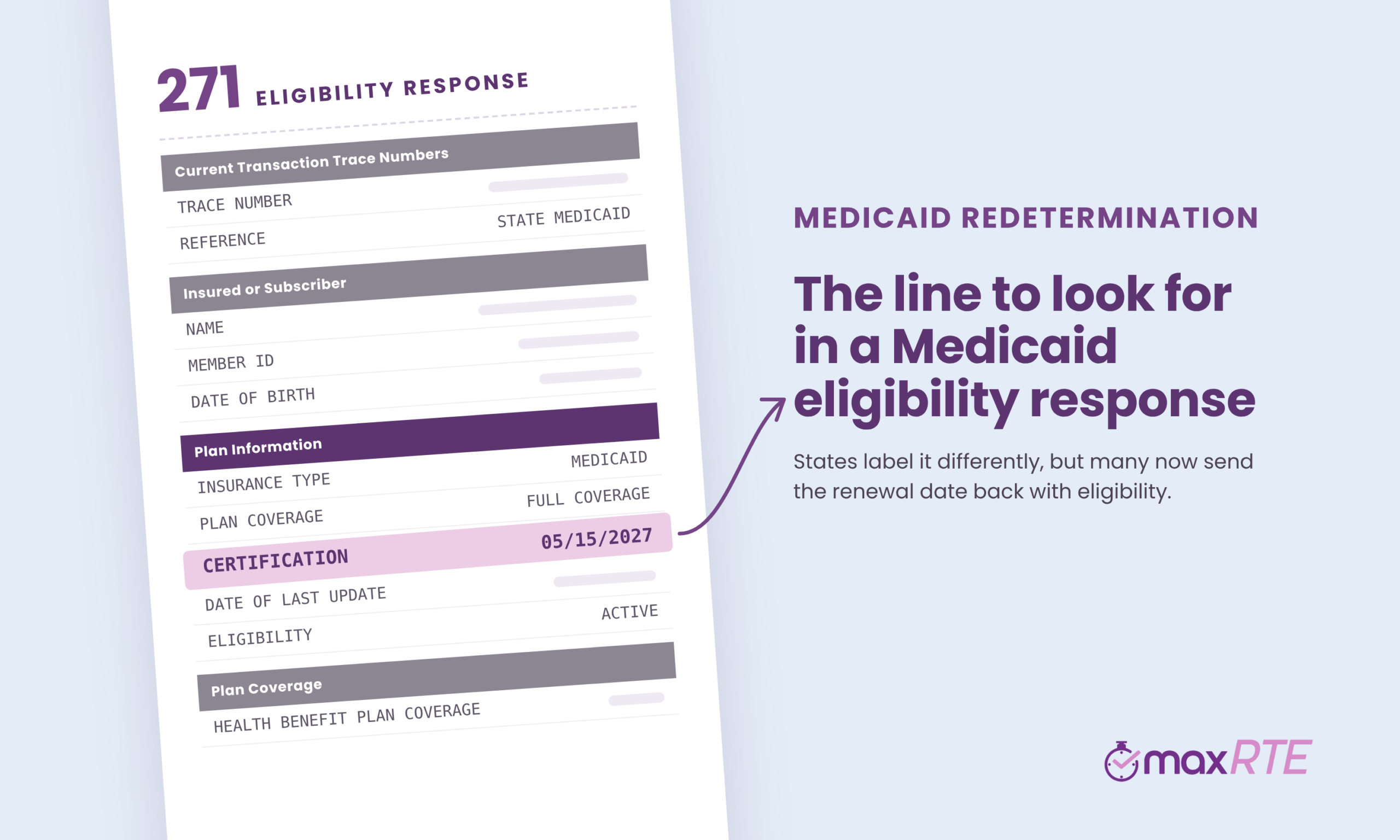
Ahead of the One Big Beautiful Bill’s Medicaid changes, many state Medicaid programs are returning a patient’s redetermination date in the payer’s 271 eligibility response. That date tells you when their coverage is up for renewal, so patient access and financial counseling teams can see a coverage risk before it turns into a denial.
With new work requirements and more frequent renewals arriving in 2027, more lead time gives your teams a window to help patients gather the documentation they’ll need to keep their Medicaid coverage active.
Why the renewal date matters more in 2027
Three changes from the One Big Beautiful Bill put more weight on each renewal for Medicaid expansion adults.
- Work requirements. By January 1, 2027, expansion adults ages 19 to 64 need 80 hours a month of work or another qualifying activity, or an exemption, to keep coverage.
- Six-month renewals. Expansion adults move from annual renewals to renewals every six months beginning in 2027, so the renewal date comes around twice as often.
- A shorter retro window. Retroactive coverage drops from three months to one month for expansion adults (and two months for traditional enrollees), leaving less room to recover a missed renewal after the fact.
We looked at the full policy timeline in The One Big Beautiful Bill: What RCM Leaders Need to Know and Do Now.
Where the renewal date shows up
The redetermination date comes back in the 271 as a date tied to the patient’s Medicaid coverage. Illinois, for example, sends it as the “certification” date, which it also calls the Renewal Due Date. The label and whether the date is included vary by state.
How maxRTE Real-Time Eligibility can help
maxRTE Real-Time Eligibility runs eligibility checks inside Epic at scheduling and check-in, so the renewal date shows up where staff already work.
Behind every response, maxRTE pulls the 271 before it reaches the chart, retries errors, and keeps payer mappings and coordination of benefits logic current so coverage loads onto the account correctly. If a patient’s Medicaid does end, Insurance Discovery searches for other active coverage, including retroactive Medicaid, before the account is treated as self-pay.
Getting ready for the 2027 Medicaid changes? Schedule a demo with our team.